IMPORTANT NOTICE: It may seem that your business operations are going fine; a few delays here and there are not a big deal, and you don’t have to spend a fortune hiring a
custom software development company. But once you finish reading this blog, you will know how important it is for growth, scalability, reputation, and performance.
The custom software development market is expected to reach 146.18 billion by 2030, directly reflecting rising demand.
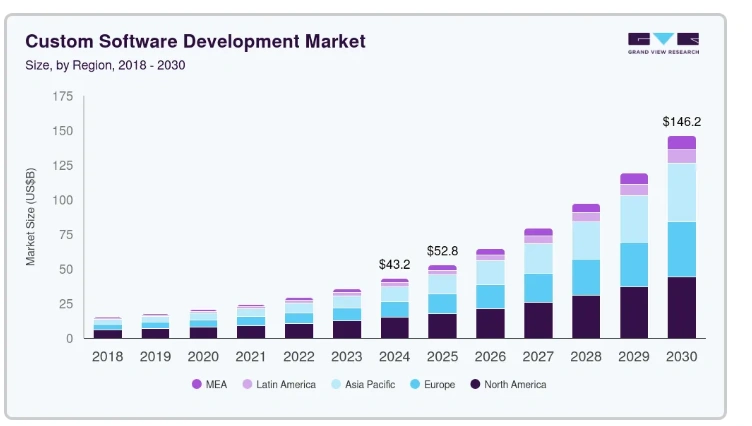
Data Source:
Grand View Research
So, does that mean off-the-shelf solutions aren’t sufficient to meet all business needs? The honest answer is no. See, such solutions are nice, they are easy to handle, easily available, cheaper, and all that stuff, but they are generic solutions. They can automate and streamline common workflows such as payroll and document management. However, when it comes to workflows specific to your business, such as specific security checks or data extraction, you might not find features to support them.
That is why bigger companies with multiple departments and complex workflows often choose custom software over ready-made tools. But this is not the real problem; the real problem is that most companies take years to realize that they badly need custom software, which significantly affects operational accuracy and efficiency.
Just so you don’t suffer the same fate, we have put together this blog, which gives you a closer look at what custom software can do, whether you really need it, and how to proceed with development.
This is going to be an interesting journey, and we hope you will find your solution by the end of this piece.
What Is Off-the-Shelf Software?
Off-the-shelf software refers to pre-made tools designed to assist businesses with specific operations such as payroll management,
CRM, project management, communication, minor automations, and more.
In simpler terms, any application not specifically built for a particular business is called an off-the-shelf application. Take
Microsoft Teams, for example. It’s an application that any business can use to streamline their internal and client communication.
Such solutions can be beneficial for startups, small businesses, or even mid-cap businesses with fewer operational complexities. They are easily available on Google and often come with automated upgrades.
However, when we talk about businesses handling multi-layered workflows across multiple departments, off-the-shelf solutions might not be suitable, as they offer limited features.
In simpler terms, if a business with unique operational needs chooses ready-made software, it might need to purchase additional software to streamline all of its operations. Moreover, managing separate tools only makes the process cluttered, ultimately slowing down efficiency.
So, if you are starting your business, readymade software solutions will work for you. It’s easily available and cost-effective, which is what you will focus on in the starting years. But if you are already running a large-scale business, this will only make the process worse.
What Is Custom Software?
Custom software is a tool or application especially designed for your business. They are not available online. To have one, you need to hire a
custom software development company to analyze your business needs and develop software with features tailored to your workflows, automation requirements, communication layers, and more.
You might have noticed that many IT companies have their own HR systems that track employees’ working hours, leave, etc. Those are custom software.
Unlike off-the-shelf solutions, custom software doesn’t have generic features but the ones specifically built to meet your unique needs. Moreover, with a single readymade software, you won’t see measurable results because its features are limited.
On the other hand, you can have all the features and functionality needed to streamline workflows across stages, execution cycles, and departments on a single custom software platform. It eliminates the chances of
data silos, communication gaps, and late updates, making management smoother.
So, are only bigger businesses eligible for custom software solutions? Absolutely not. They are the most common ones using such solutions, but smaller businesses can also enjoy the benefits.
Any business struggling with communication gaps, glitches, data silos, or any kind of executional delays can consider custom software development services in Calgary.
10 Signs Your Business Needs Custom Software
Congratulations, guys! We have finally arrived at the most-awaited section of this blog. So, how does a business become aware that it’s time to upgrade to custom software? You just have to look for these signs:
1. Your Team Uses Too Many Separate Tools
Go to your office, call your managers, HR, and all the IT people in your cabin, and ask how many tools they use, how often they use them, which one is most used or important, etc. Gather all the information and write it down somewhere.
Now, analyze whether these tools are driving the results you want. If they are delivering the desired results within the set timeframe and you have no complaints about delays from clients, customers, or team members, you can continue.
However, if you see that all the tools are making very little or no difference to operational efficiency and growth, and you have witnessed unnecessary delays and complexities, it’s the right time to opt for custom software.
2. Your Processes Are Becoming Inefficient
Managers and team leads will get this point. If you notice your operational workflows are slowing down, it means there’s a problem with your existing tools.
Now, it’s not easy to track such inefficiencies because they aren’t always measurable, and you can’t sit with every department to see which team is struggling with a slower speed and why. What you can do is have a meeting with your managers and team leads, ask them to continue observing their respective workflows for a month or two, and keep track of any blockages or glitches affecting output speed.
After that, you will have a clear picture. Now, you need to analyze how to eliminate those inefficiencies. Would small modifications work? If yes, how much would you have to spend?
If the budget exceeds and the upgrades are limited, invest in building your first-ever custom software.
3. Off-the-Shelf Software Doesn’t Fit Your Workflow
If you have ever been in a situation where you wanted to automate a particular task or a workflow but none of your existing tools have that specific feature, it’s a sign.
As mentioned earlier, it is impossible to get everything done with ready-made software; it only offers common functionalities. So, if you imagine a software that does it all for you without making things more complicated, consult with a
custom software development company.
4. Integration with Other Systems Is Difficult
Businesses operating with legacy systems often find it difficult to upgrade to modern workflows that give them the needed efficiency because ready-made software isn’t easy to integrate with existing systems.
If the above situation sounds familiar, it means you finally need custom software to achieve modern-day accuracy and efficiency.
5. You Are Paying for Features You Don’t Use
You need to do some deep digging for this. Go through all the tools your company currently uses and make a list of features that are not in use. It’s gonna be a big number because ready-made tools often come with features that are either unnecessary or not suitable for your kind of business operations.
But the amount you pay for monthly or yearly subscriptions includes those needless features, so you are wasting money. When you build custom software, you only pay for the features you want, which saves a lot.
6. Your Business Is Growing Rapidly
Look at your growth charts. Are you witnessing consistent milestone achievements? If yes, it’s time to move on from those off-the-shelf solutions and invest in custom solutions. Readymade tools don’t support scalability, and upgrading their features isn’t always possible. Even if it is, you have to pay a handsome amount.
7. Data Security and Compliance Are a Concern
The clients who come to us for custom software development often give this reason. Readymade tools can be faster and cost-effective solutions, but in return, you gotta compromise somewhere.
Every business follows different security and compliance protocols, and finding them in such solutions isn’t possible. So, if your business belongs to an industry where you can’t compromise on the security and regulatory compliance part, it’s better to switch to custom solutions.
8. Reporting and Analytics Are Limited
If your team isn’t satisfied with the current reporting and analytics system due to frequent glitches, slow updates, and low accuracy, upgrading to custom software will be highly beneficial. Well-structured charts, real-time data insights, and consistent updates will make the process much easier to understand and further increase executional accuracy and efficiency.
9. Customer Experience Is Suffering
Are you witnessing a sudden drop in the customer engagement rates? Well, it’s a clear sign that your app, website, or online store isn’t providing what they want. Nah, following the latest market trends isn’t enough; you need advanced customer behavior-tracking features to help you develop better strategies for the future. So, where do you find that? In custom software.
10. Your Competitors Are Innovating Faster
If you ever feel that your competitors are just moving too fast, that’s a problem. They are not moving fast; you are being slow. Businesses that use custom software can automate most of their workflows and focus more on bringing innovation.
Key Benefits of Custom Software for Growing Businesses
We know we have already discussed the benefits in the definitions and signs above. However, this section will provide more clarity on why Custom software development is a better option.
Tailored Functionality
No more paying for unused features or buying multiple software just to get that one workflow streamlined. Custom software includes features specially designed for your unique operational needs. This way, you are paying just for what you actually use and benefit from.
Better Integration with Existing Systems
No need to redesign those legacy systems, since custom software solutions integrate seamlessly with them. It means you can upgrade to a smoother, more streamlined process without settling for manual adjustments or separate management.
Scalability for Future Growth
Most businesses struggle to redesign their software or shuffle between tools whenever a new milestone is achieved. With custom software solutions, you can do better. Whether the user base has increased, a new service or product has been added, or advanced features have been included, it can handle it all.
Enhanced Security
When a business decides to get custom software, they choose high-end security features such as continuous monitoring, advanced reporting, instant blocking of suspicious activity, risk management, and more. It allows businesses to keep their data safe throughout the decades.
Long-Term Cost Efficiency
If we talk about initial investment, custom software will be the more expensive option. However, if you count the amount spent on manual upgrades, subscriptions, and maintenance of the readymade tools, you’ll notice that custom software is actually cost-effective in the long run.
In short, one big initial investment in quality-built software is better than small investments in mediocre solutions now and then.
Custom Software vs Off-the-Shelf Software: Quick Comparison
We have created a table to clearly compare the two software types and help you make informed decisions.
| Aspects |
Off-the-shelf |
Custom Software |
| Initial Cost |
Low initial investment but higher subscriptions and maintenance charges. |
High initial investment, but no subscription or maintenance charges. |
| Deployment Time |
Can be deployed within a week or two. |
Takes 6 to 12 months, depending on complexity. |
| Customization Level |
Limited customization available. |
100% customization available. |
| Workflow Compatibility |
Less compatibility to fit unique workflow needs. |
Highly compatible to fit a wide range of business needs. |
| Scalability |
Limited scalability options. |
100% scalable software. |
| Integration Capabilities |
Difficult to integrate with existing systems. |
Seamlessly integrates with existing systems. |
| Feature Relevance |
Includes unnecessary features. |
Only includes necessary features. |
| Data Ownership & Control |
Limited control and ownership over data. |
100% ownership of the software. |
| Competitive Advantage |
Low competitive advantage. |
High competitive advantage. |
| Maintenance & Updates |
Handled by the software provider. |
Handled internally. |
When Off-the-Shelf Software Still Makes Sense
So, when can you settle for off-the-shelf solutions? If you fit into the following scenarios:
Startups with limited budgets
If you have just started your business and are on a budget, going with off-the-shelf solutions is a better option.
Simple workflows
If your business doesn’t have highly complex workflows, there’s no need to invest in
custom software development services in Calgary.
Temporary solutions
If you are not sure about custom software and just want a temporary solution to manage seasonal workloads, readymade solutions are enough.
How Cyber Ace Helps Businesses Build Custom Software
Here’s where the actual magic lies. It’s not only the software itself but how it’s built that determines whether it will actually fit your needs. Below, we outline the steps we take to deliver the software of our clients’ dreams.
Initial Consultation and Requirement Analysis
At
Cyber Ace, development doesn’t start directly with writing code but with understanding your needs first. When you first reach out to us, we schedule a detailed consultation call with you during which our developers analyze your business needs and suggest the best solutions.
Software Blueprint and Strategy Design
After the initial consultation and your approval to move forward, we begin designing the software blueprint. All the details of the UI design, features, integrations, SEO compatibility, and more are outlined in this blueprint.
UI/UX Design and Prototyping
Once the blueprint is finalized, our highly skilled team of UI/UX designers starts creating the user interface and experience. This is where the part you interact with most is created.
Custom Software Development
After the UI/UX design is finalized, our developers take over and convert the static designs into fully functional interfaces using advanced coding practices.
Integration with Existing Systems
In this stage, the software is integrated with the existing system to check for any compatibility issues.
Testing and Quality Assurance
If no issues are found, a quality test is conducted to identify system glitches, bugs, and other issues. This helps in ensuring smooth software performance.
Deployment and Implementation
After that, all the handover formalities are done, and the software is delivered to you.
Ongoing Support and Continuous Improvement
Our support team is available 24/7 if you encounter any technical issues after the launch.
Frequently Asked Questions
- What’s the main difference between custom software and off-the-shelf software?
Custom software is built specifically to meet your business needs, while off-the-shelf software is a ready-made solution from software vendors that supports basic workflow management.
- Is custom software development more expensive than off-the-shelf solutions?
No. The initial investment in custom software can be high, but it avoids the costs of ready-made software subscriptions, maintenance, etc.
- How long does it take to develop custom software?
It depends on the software’s complexity. If it’s an MVP model, it takes 4-8 weeks. However, medium to enterprise-grade projects take 12-18 months to complete.
- Can custom software integrate with existing tools?
Yes, custom software can integrate with pre-existing systems.
- Is custom software secure?
Yes, custom software offers much better security than off-the-shelf solutions.
- When should a business switch to custom software?
If a business isn’t witnessing any progress in its operational accuracy and efficiency, it’s time to switch to custom software.






1 Comment
sasdsa